Brain Tumours: Types, Warning Signs and Treatment
12 June 2026 · By Neurosurgery.mu · Updated 17 June 2026
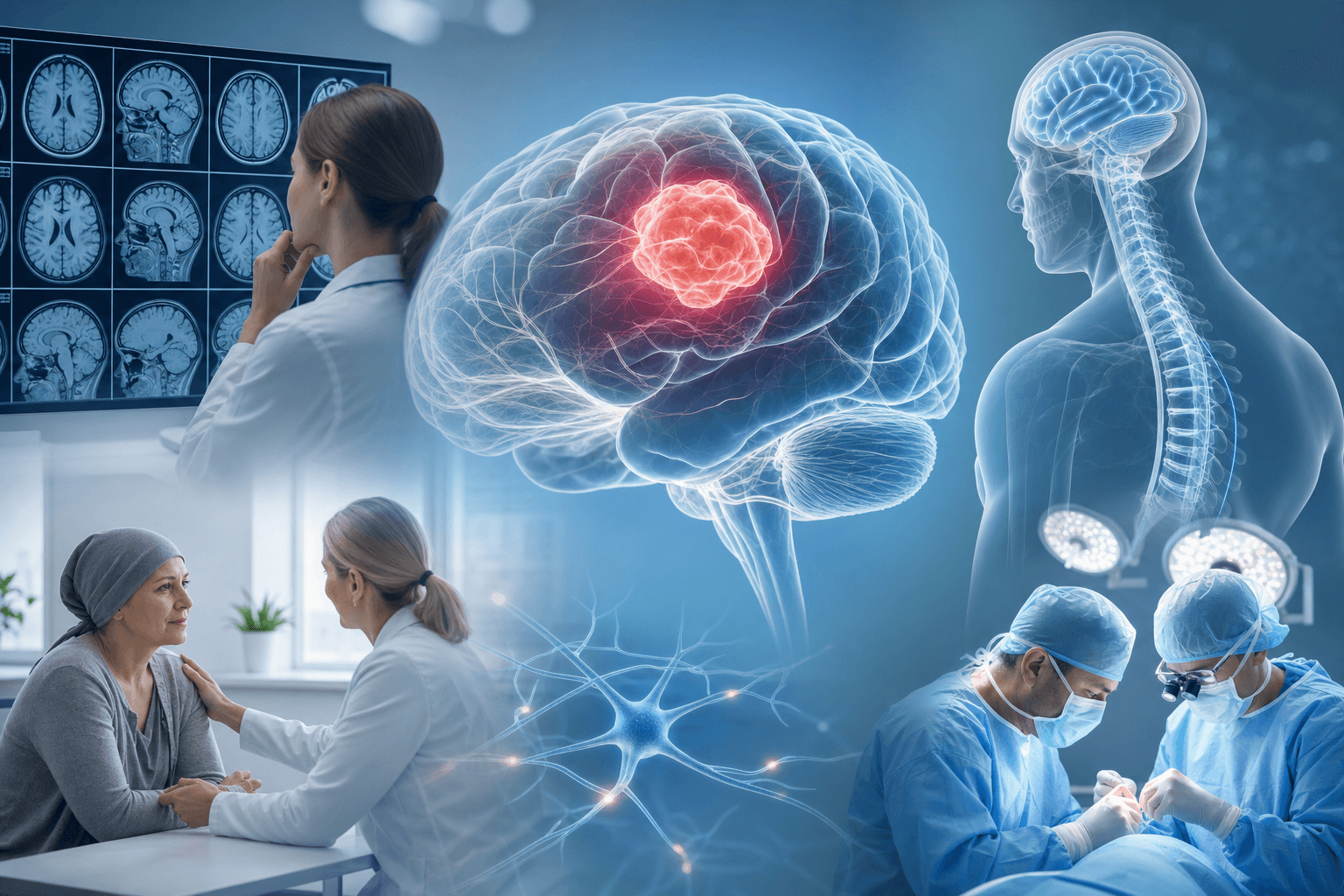
Hearing the words "brain tumour" can be frightening, but it helps to know that this term covers a very wide range of conditions. Many brain tumours are slow growing and harmless, and even those that need treatment can often be managed well. This page explains what brain tumours are, the signs to watch for, how they are diagnosed and the options available, so that you and your family can feel more informed and less anxious.
What a brain tumour actually is
A brain tumour is a growth of cells inside the skull. Doctors group these growths in two broad ways. The first is by where they come from. A primary tumour starts in the brain itself or in the tissues around it. A secondary tumour, also called a metastasis, has spread to the brain from cancer elsewhere in the body, such as the lung or breast.
The second way is by behaviour. Benign tumours grow slowly, stay in one place and do not invade nearby tissue. Malignant tumours grow faster and can be more difficult to remove completely. It is worth remembering that the word "tumour" simply means a lump or growth. It does not automatically mean cancer.
Common types you may hear about
Several types come up often in clinic. Meningiomas grow from the membranes that cover the brain and are usually benign and slow growing. Gliomas arise from the brain's supporting cells and range from low grade and gentle to higher grade and more demanding to treat. Pituitary adenomas form in the small hormone gland at the base of the brain and are almost always benign. Acoustic neuromas (also called vestibular schwannomas) grow on the nerve linked to hearing and balance. Knowing the type matters, because each one behaves differently and is treated differently.
Warning signs to be aware of
Most headaches are not caused by a brain tumour, and most of the symptoms below have far more common and harmless explanations. Still, it is useful to know which patterns deserve attention.
- Headaches that are new, steadily worsening, worse in the morning or that wake you from sleep
- A first ever seizure or fit in an adult
- Persistent nausea or vomiting that is not explained by a stomach upset
- Gradual weakness, numbness or clumsiness on one side of the body
- Changes in vision, hearing, speech or balance
- Changes in memory, personality or concentration noticed by you or those close to you
A single mild symptom on its own is rarely a cause for alarm. It is the combination, the persistence or the steady worsening over weeks that should prompt a medical review.
How brain tumours are diagnosed
Diagnosis usually begins with a careful conversation about your symptoms and a neurological examination, where the doctor checks your strength, reflexes, vision, balance and coordination. If imaging is needed, an MRI scan is the most detailed and is generally preferred. A CT scan may be used first if it is quicker to arrange or if MRI is not suitable for you.
If a growth is found, more tests may follow. Blood tests can check hormone levels, and in some cases a small sample of tissue (a biopsy) is taken so that the type and grade can be confirmed under a microscope. This step is important, because the exact diagnosis guides every treatment decision that follows.
The range of treatment options
Treatment is always tailored to the individual, taking into account the type, size and position of the tumour, your symptoms and your general health. The plan is usually made by a team that may include a neurosurgeon, an oncologist and a radiologist.
Watchful waiting is a genuine and often sensible option. For small, slow growing, benign tumours that cause no symptoms, the safest course can be regular monitoring with scans rather than immediate treatment. Many people live comfortably for years this way.
Medication may be used to ease symptoms, for example to reduce swelling around a tumour, to control seizures or to correct hormone imbalances from a pituitary tumour.
Surgery is a common option when a tumour needs to be removed or when a sample is required. Modern neurosurgery uses precise imaging and careful techniques to remove as much of the tumour as is safely possible while protecting healthy brain tissue.
Radiotherapy uses focused beams of energy to shrink or control tumour cells, and highly targeted forms can treat small or hard to reach growths very accurately. Chemotherapy uses medicines to slow or stop tumour growth and is used for certain types, sometimes alongside surgery or radiotherapy.
Often the best results come from combining these approaches.
This page offers general education only and is not a substitute for personalised advice from a qualified doctor who knows your situation.
When to see a specialist
Please arrange a medical review if you have a first ever seizure, a headache that is clearly different from your usual pattern and steadily worsening, or any new and lasting weakness, vision change or difficulty with speech or balance. Your family doctor can assess you and refer you for imaging or to a neurosurgeon if needed. If symptoms come on suddenly or severely, seek urgent care.
A calm note to end on
The path from a worrying symptom to a clear answer can feel long, but each step exists to give you the right information and the right plan. Many brain tumours are benign or highly treatable, and a great deal can be done to protect both your health and your quality of life. Bring a list of your symptoms and a trusted person to your appointments, ask questions freely, and remember that you do not have to face any of this alone.
Clear information is the first step in good brain and spine care. Explore the wider Medtech health ecosystem.